![[personal profile]](https://www.dreamwidth.org/img/silk/identity/user.png)
This fictional version of how Charles Dickens, at a low ebb in his writing career, came to write A Christmas carol is full if self-referential quirks and peopled by a host of reliable British thesps as the characters running riot in Dickens imagination. Christopher Plummer steals the show as Scrooge, but in addition there’s Jonathan Pryce, Miriam Margolys, Simon Callow, Donald Sumpter. I thought at first there was an echo of Shakespeare in Love (when Shakespeare hears ‘a plague on both your houses’ and it comes back out of his pen with a different twist) but this was much more upfront. The characters take over Dickens imagination and lay waste to the creative process until he finally gets it. Dan Stevens plays the beleaguered Dickens snatching inspiration from people he meets, such as the cadaverous waiter (Sumpter) who becomes Marley. It’s cheesy with a light touch, easy to swallow, and probably destined to be one of those films that crops up regularly on afternoon TV in December.
Dec. 19th, 2017


The Force Awakens gave us all what we needed, a retelling (almost) of Episode IV in which the girl from nowhere made good and began to discover the Force for herself. It introduced us to a host of new characters: Rey, Finn, BB8 and the unfortunately named Poe* Dameron.
In the Last Jedi our expectations are acknowledged and then thoroughly subverted. Dameron is not a Han Solo for a new age. His hot-headed alpha-masculinity leads to actions that are (at best) misguided. He’s not infallible. He sometimes gets the job done, but at what price. Characters make mistakes—even Luke—but though it’s a dark time for the rebels not all is lost. There is redemption for Luke and Mark Hamill is utterly convincing as the conflicted ‘last’ Jedi.
Rey thinks she can turn Kylo Ren (Ben Solo) back to the light, but can she? Snoke thinks he can turn Rey to the dark, but does he?
We meet a new character, Rose Tico (Kelly Marie Tran), an unlikely heroine, but all the better for that.
The women in this movie have it, from Leia to Admiral Holdo. They subvert the idea of the alpha male as the logical choice for the leadership. “Not every problem can be solved by jumping into an X-Wing and blowing stuff up,” says Leia. Yeah! Hopefully Dameron learned a few valuable lessons.
And then right at the end one of the small seeds planted in this movie begins to sprout as an unnamed stable boy reaches out for his broom and it comes to his hand courtesy of the Force.
Loved it.
*(I’m sorry but I can’t take anyone seriously whose name is Poe. Disney, you should really have checked out the names against common slang. In the UK a ‘po’ is a chamber pot! Even Wikipedia could have told you that.)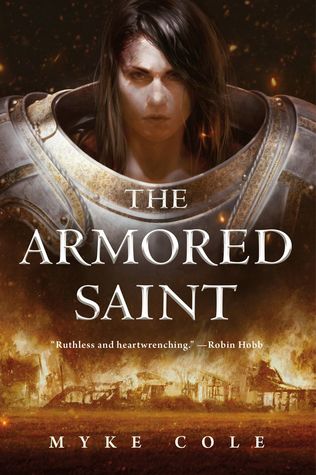 Not due for publication until March 2018. I had this short novel (maybe a novella) for review as an advance reading copy from Netgalley. This is a fantasy setting in which, following some kind of religious war, bands of holy warriors—the Order—have the power to root out and kill wizards without trial, often cruelly. If they decide a village is sheltering a wizard, there’s no mercy. Supposedly wizardry opens up the way for hell’s demons to come through into the world—and no one wants that. Heloise and her father meet up with the Order on the road to the next village, Hammersdown, and Heloise talks back, never a good idea. Her initial mistakes are compounded and eventually everyone suffers for it. Later the order takes it out on Hammersdown and Heloise is forced to see things that no one should have to see. It’s inevitable, therefore, that the order comes looking for Heloise and her family. Character-driven, this is a deep study of Heloise in adversity but the supporting characters work well, too. The writing is visceral. It drew me in quickly and didn’t let me go, even delivering something unexpected at the end.
 This is the first part of a trilogy, translated from the Swedish. It’s a fictionalized story of real-life historical character Arn Magnusson, based around historical events before Sweden was a united single country. This is Arn’s early life, much of it set in a monastery where Arn grows up to be both pious and naïve, so when he’s sent back to his family he knows so little of the world that he manages to sleep with two sisters (consecutively, not together – it’s not that sort of book) which gets him into hot water with the church, especially since the first one is a scheming minx and the second one turns out to be the love of his life. The pace is measured (OK, OK, it’s slow) but there’s interesting detail and the Nordic background is fascinating.
 Abigail Wendover, a spinster in her late twenties and a respectable resident of Bath, is trying to detach her impressionable young niece from a fortune hunter with whom she is madly in love. Feeling as though she’s past the age where she needs to observe the strict regime demanded of young women of marriageable age, Abby’s a little more independent than your average Regency miss, and her direct speaking sparks off a friendship with a rogue, Mr. Miles Caverleigh, the black sheep of the title and also, unfortunately (or maybe fortunately) the uncle of the fortune hunter. Yes, it all turns out well in the end, this is Georgette Heyer, after all. Very amusing. One of the better Heyer ‘Regencies’, I think.
Booklog 72/2017 - Andy Weir: Artemis
Dec. 19th, 2017 03:42 am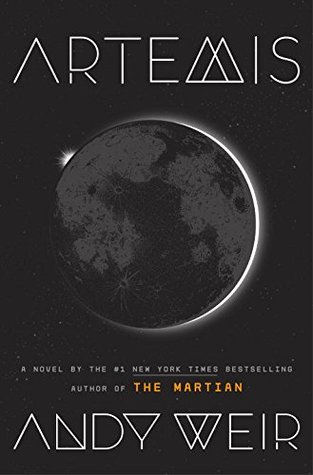 Question: how to top a book like The Martian? Answer: You probably can’t.
 An intriguing premise. In the early years of the twentieth century, just before World War I, Jane, a flautist, is spirited away to Spellhaven where the spirits of the city have to be entertained to keep them sweet. Talented musicians, actors, entertainers of all kinds are brought to the city, some willingly, some not, signing contracts for (usually) a three year term with the Lords Magician (the alternative is to get thrown into Spellhaven’s jail). Jane signs up for longer than the minimum term on condition that she’s taught magic. She wants to force a duel on Lucian Palafox, the magician who brought her to Spellhaven against her will. But time passes and things change – and then there’s a catastrophe. This is a book of two halves, a before-and-after book. It's beautifully written, but sadly I found the ending unbearably sad, a little too bleak for my taste.
 I’ve been reading this on and off all year, for research for my upcoming book, Rowankind. I tend not to blog non-fiction because I dip in and out of books for research without reading them from cover to cover, but I did end up reading all of this. It’s a fascinating study, full of rich (and useful) details about resorts, bathing machines, dippers and the saltwater cure. I was specifically looking for links to George III's bathing habits, and there they were!